
Anime Expeditions Tier List: Best Units Ranked
Anime expeditions tier list explaining top units, support picks, farming value, control roles, and update-sensitive rankings for players now.
Quick answer
The anime expeditions tier list should not be read as a pure damage chart. The collected sources agree that strong units are judged by damage, amplification, control, economy, team synergy, abilities, passives, and investment cost. Several names repeatedly appear near the top: 8th Sword or 8th Sword (Berserk), Shadow or Shadow (Divine), Puppet or Puppet (Telekinetic), Cursed Student or Cursed Student (True Love), Toy Maker, Elf Mage, Salmon Sorcerer, and Ramen Guy.
The safest conclusion is that Shadow, 8th Sword, Puppet, Cursed Student, and Toy Maker are high-priority units across multiple sources. Ramen Guy is important for economy rather than raw DPS. Salmon Sorcerer is more valuable as control than as a simple damage pick. Any exact order needs verification because the sources use different S, SS, and S+ systems.
How this tier list is built
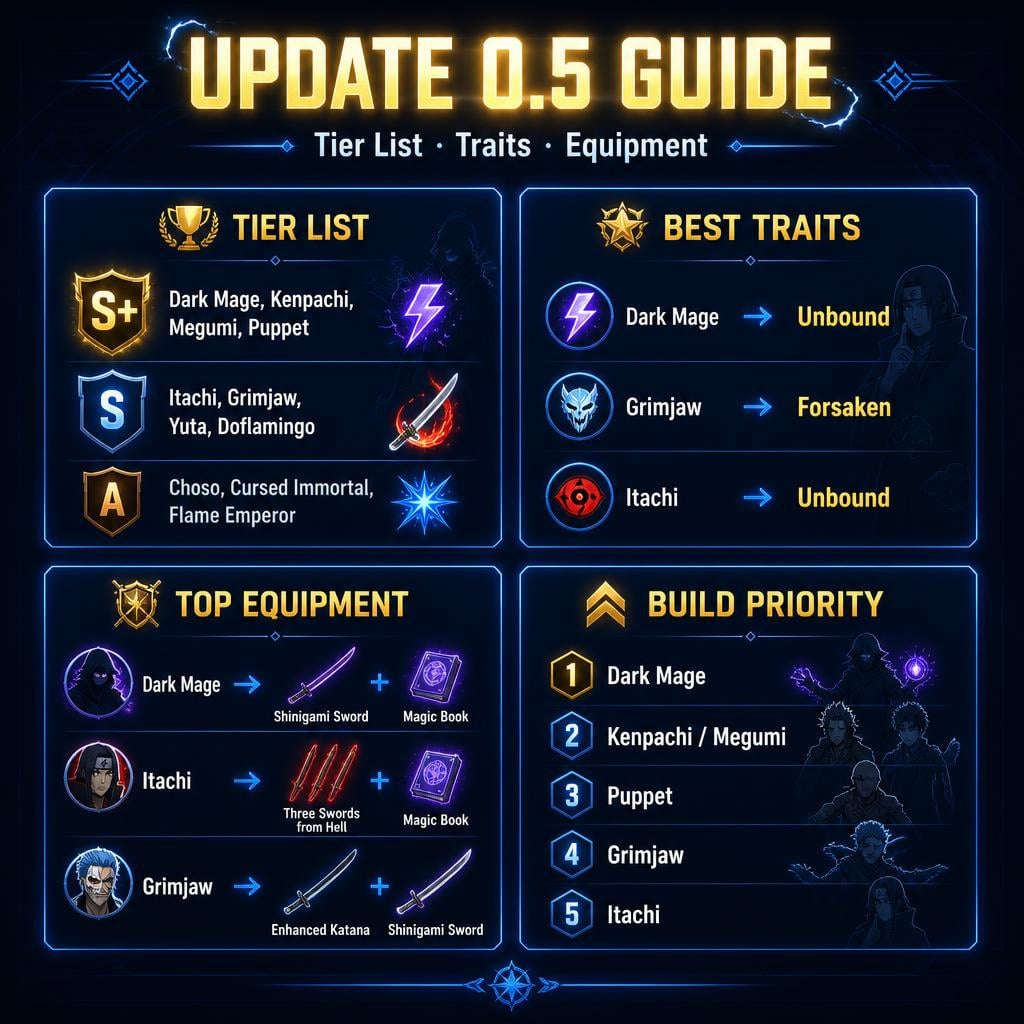
One source frames the ranking as a July 2026 release-unit tier list and warns that it changes with balance updates. Another calls its ranking community-submitted and provisional, not an official tier list or full equal-setup DPS test. MrGuider adds Update 0.5 notes, support rankings, crowd control rankings, and trait context.
That means this page uses a role-aware ranking model. Units that appear in multiple high tiers are treated as safer recommendations. Units that are strong in only one role are described by that role instead of forced into a single universal score. When sources conflict, the page marks the point as needing verification.
Best overall units
The best overall units from the cross-check are 8th Sword (Berserk), Shadow (Divine), Puppet (Telekinetic), Cursed Student (True Love), Elf Mage (Unleashed), Toy Maker, Salmon Sorcerer (Grade 1), and Ramen Guy. These names appear because they answer different parts of a team, not because every one does the same job. A good Anime Expeditions roster usually needs carry damage, utility, control, and economy.
Shadow (Divine) is repeatedly described as a strong all-around option, with value connected to summons, enemy rewind, damage, and Magical team support. 8th Sword (Berserk) appears as a major carry candidate. Puppet (Telekinetic) is highlighted for boss amplification, which can make difficult enemies take more damage.
Support, control, and farming
Support and crowd control matter more than many beginner tier lists admit. MrGuider's support ranking includes Puppet (Telekinetic), Forbidden Teacher, The Hero, Shadow Divine, Crow (Black Fire), and Water Princess. Its crowd control list includes Salmon Sorcerer (Grade 1), Shadow Divine, Puppet (Telekinetic), RazorJaw (Hunter), Ice Queen, String Demon (Awakened), 8th Sword, and Ice Mage.
Ramen Guy is the clearest farming or economy example. One source warns players not to throw Ramen Guy away only because its damage is lower. In longer stages, faster Yen flow and upgrade tempo can be more important than adding another unfinished DPS unit.
Update 0.5 and changing ranks
Update 0.5 is reported to have arrived on July 25, 2026, and one source says it added new units including Crow and Crow (Black Fire). Other best-units research mentions Crow (Black Fire), Dark Mage (Sovereign), Razorjaw (Hunter), and Cursed Immortal (Black Sun). Because the collected pages do not all list the same Update 0.5 additions, treat the full update roster as needing verification.
The practical takeaway is simple: never spend all resources from an old tier list without checking update date. A unit can move when new traits, equipment, passives, or enemies change the meta. This is especially true for Roblox tower defense games where patches can reshape both early progression and late-game teams.
How to use the list
Use the anime expeditions tier list as a shortlist, not as a command. Pick one strong carry, then add amplification, control, and economy around it. Compare each unit with its traits, equipment, and current team role before deciding whether to invest.
If you are new, avoid chasing every top-ranked name at once. Build a usable team first, then upgrade your long-term units. If a source ranks a unit high but does not explain its role, mark the claim needs verification and wait for better testing.
FAQ
Is SS always better than S? Not necessarily, because different sources use different tier systems. A unit marked SS in one list may be role-dependent in another. This page treats repeated high placement across sources as stronger evidence.
Is DPS the only ranking factor? No. The research repeatedly mentions damage amplification, control, blocking, economy, passives, traits, equipment, and team composition. Anime Expeditions rewards complete teams more than six random high-damage units.
Source conflicts to watch
String Demon and True Saint are examples of units that appear very high in some source structures but are more cautious in others. That does not mean they are bad. It means their value may depend on role, testing method, traits, equipment, or the stage being discussed.
Ramen Guy creates another kind of conflict because farming value is hard to compare with DPS. A damage-only ranking may push Ramen Guy down, while a team-building guide may treat it as important. This page therefore separates economy from pure damage rather than forcing both into the same lane.
Updating this ranking
Every future update should refresh three sections: best overall units, support/control units, and update notes. If new units enter the game, they should not automatically outrank proven units until sources explain their role. If a new unit appears in only one source, mark it as needing verification.
The best evidence is repeated placement across several current guides plus a clear explanation of role. A list with names but no method is weaker than a list that explains carry, support, control, farming, and investment cost. That method keeps the tier list useful even when the exact order changes.
Beginner reading order
If you are new, read this tier list after checking codes and before spending trait or equipment resources. Codes may give reroll materials, but a tier list helps decide which units deserve those materials. This prevents a common mistake: redeeming rewards, then using them on units that are not part of a long-term plan.